
How much does freight shipping cost?
How much freight shipping costs comes down to the same six inputs on almost any quote:
- A base rate for the vehicle or the lane.
- Distance. Per mile for a local truck, or by origin and destination for LTL and truckload.
- Weight and size. Heavier and bulkier freight costs more. LTL rates are usually figured per hundred pounds.
- Freight class, for LTL. More on that below.
- Accessorials. Liftgate, pallet jack, waiting time, appointments, inside delivery and the other extras below.
- Fuel. A surcharge that rises and falls with the price of diesel.
For local freight in Southern California, the Alvy Logistics 2026 card is short: a 20 to 26 ft box truck starts at $200 for the first 20 miles. After the first 20 miles, mileage can start as low as $1.20 a mile, depending on the vehicle and the route, and it is set on your written quote. Any accessorials the job needs are listed on the quote too. The truck is booked for the trip, so the price does not climb pallet by pallet, though a load over 1,000 lbs adds a weight charge.
What is freight costing in 2026? Fuel and market data
Freight got more expensive over the past year, and diesel rose about 73%. These are the public figures as of October 2026, each from the agency or carrier that publishes it.
| Indicator | Latest | Change from a year earlier | Source |
|---|---|---|---|
| U.S. on-highway diesel, per gallon | $6.276, week of October 19, 2026 | Up about 73%, from $3.620 in the week of October 20, 2025 | EIA |
| California on-highway diesel, per gallon | $8.242, week of October 19, 2026 | Up about 68%, from $4.898 in the week of October 20, 2025 | EIA |
| Old Dominion LTL fuel surcharge | 53.32%, quoted for October 28 to November 3, 2026 (from the October 19 diesel price) | Up from a 27.07% year-ago average | Old Dominion |
| Estes LTL fuel surcharge | 56.80%, from October 21, 2026 | Up from 29.0% on October 22, 2025 | Estes |
| Producer price index, LTL general freight trucking | 539.297, September 2026 (preliminary) | Up 19.8%, from 450.163 | BLS |
| Producer price index, truckload general freight trucking | 219.384, September 2026 (preliminary) | Up 17.9%, from 186.058 | BLS |
| Cass Freight Index, expenditures | 3.970, September 2026 | Up 20.4% year over year | Cass Information Systems |
| Cass Freight Index, shipments | 1.062, September 2026 | Up 1.9% year over year | Cass Information Systems |
Diesel. The EIA weekly U.S. diesel price was $6.276 a gallon for the week of October 19, 2026, about 73% above a year earlier. The California price was $8.242, about 68% higher. Both percentages are calculated from the EIA figures.
Fuel surcharges. Old Dominion, Estes and ABF Freight add fuel as a percentage of the line-haul charge, reset each week from the U.S. average diesel price. The Old Dominion fuel surcharge listed 53.32% for October 28 to November 3, 2026, set from the October 19 diesel price, against a 27.07% average a year earlier, and the Estes fuel surcharge was 56.80% from October 21, against 29.0% a year before. ABF Freight sets its surcharge by rule: 42.6% at $5.00 diesel, plus 0.1% for each cent above that. Old Dominion notes that two more percentage points may apply depending on origin or destination. On a $500 line-haul charge, a 53.32% surcharge adds about $267. The percentages change weekly, so check the carrier’s page in the week you ship.
Rate increases. LTL carriers also announced general rate increases in 2026, which vary by customer, lane and shipment: Old Dominion by 4.9% from October 5, ArcBest and ABF Freight by about 5.9% from June 22, and Saia by 7.1% in early July.
Market indexes. The BLS producer price index for LTL general freight trucking rose 19.8% from September 2025 to September 2026, and the index for truckload general freight trucking rose 17.9%, both calculated from the preliminary September figures. The Cass Freight Index for September 2026 shows shippers’ freight expenditures up 20.4% on shipments up 1.9%.
For a local run, the Alvy Logistics starting price is $200 for the first 20 miles by box truck, and any fuel surcharge is a line on the written quote.
What is freight shipping?
Freight shipping is moving goods that are too big or too heavy for a parcel network, usually on pallets, by truck. As a general industry norm, a shipment over about 150 lbs, or anything on a pallet, moves as freight rather than parcel. From there it travels one of three ways:
- Local box truck. One truck, straight from pickup to delivery, for freight moving around a region. This is what Alvy Logistics runs in Southern California: 20 to 26 ft box trucks driven by vetted independent-contractor drivers. See pallet shipping.
- LTL (less than truckload). Your pallets share a trailer with other shippers’ freight and pass through carrier terminals. See LTL shipping.
- Truckload. One shipper fills, or pays for, the whole trailer, which goes straight to the destination. See truckload shipping.
The LTL vs FTL guide explains where one becomes cheaper than the other.
How do you calculate freight shipping cost? Los Angeles examples
Each example is one Alvy Logistics box truck run, laid out the way a written quote is built: the $200 base covers the first 20 miles, mileage past 20 miles is set on the quote for the actual route, and extras such as a liftgate, wait time, a weight charge or a fuel surcharge each get their own line. Miles are typical road distances from pickup to delivery.
| Shipment | Assumptions | Starting point | What the quote adds |
|---|---|---|---|
| 2 pallets, local | 15 miles, 900 lbs in total, docks at both ends | $200 base, which covers the whole run | No mileage, and no liftgate with docks at both ends |
| 4 pallets of packaging, Valencia to downtown Los Angeles | 40 miles, docks at both ends | $200 base for the first 20 miles | Mileage for the other 20 miles |
| 6 pallets, Valencia to Long Beach | 63 miles, 3,000 lbs in total, no dock at delivery | $200 base for the first 20 miles | Mileage for the other 43 miles, a liftgate and pallet jack, and a weight charge |
The first run stays inside the base, so $200 is its starting price before any fuel surcharge. The other two start from the same base, and the longer the run past 20 miles, the more of the quote is mileage. The third run shows the extras most often missed. With no dock at delivery it needs a liftgate and a pallet jack, and at 3,000 lbs it is over the 1,000 lb weight threshold. Each is listed as its own line on the quote, and a Saturday run adds a weekend charge the same way.
What are accessorial charges?
Accessorial charges are fees for anything beyond a standard dock-to-dock pickup and delivery, and the usual reason an invoice lands above the quote. These are the box truck accessorials on our 2026 card. None is charged unless the job needs it, and each one that applies is listed on your written quote before you book:
| Accessorial | What it covers |
|---|---|
| Liftgate | Lowering freight from the truck bed to the ground where there is no dock |
| Pallet jack | Rolling pallets off the truck to the drop point |
| Wait time | Time held at pickup or delivery beyond a free window |
| Additional stop | Each extra pickup or drop on the same run |
| Attempted delivery | The receiver is closed or refuses, and the freight comes back |
| Pickup and hold, or hold and deliver | Freight held between pickup and delivery |
| Second person | A helper for heavy or awkward freight |
| Weight over 1,000 lbs | Each pound above 1,000 lbs on the run |
| After hours (8pm to 8am) or weekend | Timing outside business hours |
LTL carriers set their own accessorials in their tariffs. The usual ones are residential delivery, limited-access delivery (schools, construction sites and similar addresses), inside delivery, delivery appointments or a call before delivery, detention when a truck is held at a dock past the carrier’s free time, and reweigh or reclassification when the declared weight or class turns out to be wrong.
Here is what four national LTL carriers publish for those extras, from the tariff or accessorial sheet dated in each column. “Per cwt” means per 100 lb of the shipment’s weight, and the minimum applies when the per-cwt charge comes in lower.
| Accessorial | Old Dominion, October 5, 2026 | Estes, November 17, 2025 | ABF Freight, August 21, 2026 | XPO, May 18, 2026 |
|---|---|---|---|---|
| Liftgate | $4.40 per cwt, $115 minimum | $4.95 per cwt, $75 minimum | $12.50 per cwt, $235 minimum | $13.45 per cwt, $259 minimum |
| Residential delivery | $7.20 per cwt, $125 minimum | $8.50 per cwt, $75 minimum | $14.50 per cwt, $200 minimum | $16.00 per cwt, $180 minimum |
| Limited-access delivery | $7.20 per cwt, $125 minimum | $85 flat | $14.50 per cwt, $200 minimum | $16.00 per cwt, $180 minimum |
| Inside delivery | $7.70 per cwt, $125 minimum | $10.25 per cwt, $100 minimum | $18.00 per cwt, $185 minimum | $17.45 per cwt, $179 minimum |
| Notification or appointment | $30 notification, $30 appointment | $30 | $73, appointment included | $26.30 notification, $67.50 appointment |
| Detention past free time | $3.00 per minute, $50 minimum | $40 per 15 minutes (under 20,000 lb) | $5.50 per minute, $97.50 minimum | $72.25 per 15 minutes, $95.50 minimum |
| Reweigh, inspection or reclassification fee | $25 | $20 weighing, $20 inspection | $55 reclass or reweigh fee, when charges change by $10 or more | $47.85 correction fee |
| California compliance surcharge | $35 per shipment | $25 per shipment | $34 per shipment | $27 per shipment |
On lighter shipments the minimums matter more than the per-cwt figures: the liftgate minimum applies up to about 2,600 lb at Old Dominion, 1,900 lb at ABF Freight and XPO, and 1,500 lb at Estes. On a 1,500 lb shipment, all four carriers charge their liftgate minimum, because 15 cwt times the rate comes in under it: $115 at Old Dominion, $75 at Estes, $235 at ABF Freight and $259 at XPO. A reclassification re-rates the shipment at the corrected class and adds the carrier’s own fee.
Old Dominion’s detention and reweigh charges are from its ODFL 100-Q rules tariff (Items 502 and 367), and Estes’s weighing and inspection charges are from its rules tariff (Items 993 and 993-10).
What is liftgate delivery?
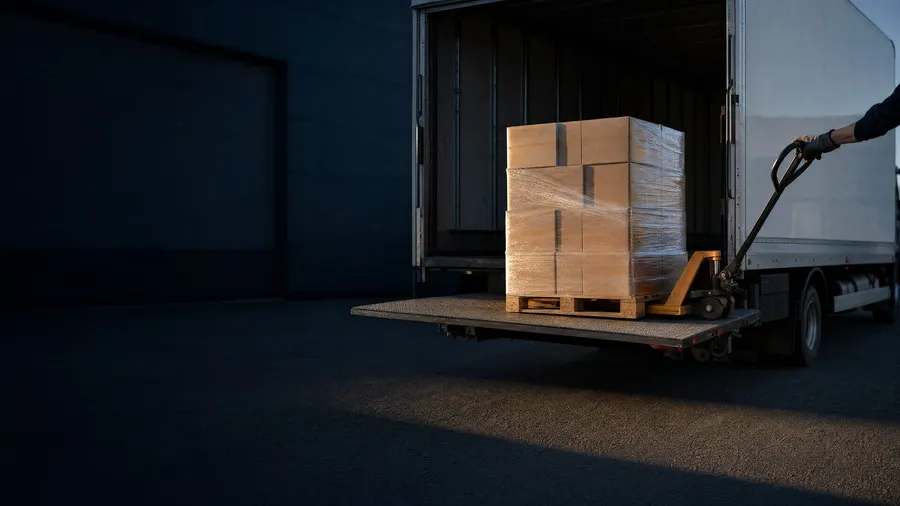
A liftgate is a powered platform on the back of the truck that lowers pallets to the ground where there is no loading dock: storefronts, offices and most job sites. On our runs it is added only when there is no dock, with a pallet jack if the pallet must be rolled inside, both listed on the quote. Not sure the receiver has a dock? Ask before you book.
How does freight class change the price?
LTL carriers price by class. Under the National Motor Freight Classification, every commodity sits in a class between 50 and 500, set by four traits: density, handling, stowability and liability. Since July 19, 2025, when NMFC Docket 2025-1 took effect, many commodities are classed by density alone on a 13-step scale, from class 400 for freight under 1 lb per cubic foot to class 50 at 50 lb or more. The denser and easier to handle the freight, the lower the class and the lower the cost per pound. Light, bulky or fragile freight sits higher. A wrong class on the bill of lading brings a reclass charge. The freight class guide shows how to work out density. Local box truck freight is not priced by class: it is the base rate plus miles and any extras.
How long does freight shipping take?
- Local box truck freight goes straight from pickup to delivery with no terminals in between, so in Southern California it can deliver the same day.
- Truckload also goes direct, so transit is set by distance and driver hours. Under federal hours-of-service rules, a driver hauling property gets at most 11 hours behind the wheel inside a 14-hour on-duty window, which starts after 10 straight hours off duty. As a rough planning figure, 11 hours at an average of 50 miles an hour is about 550 miles a day. Phoenix, about 370 road miles from Los Angeles, fits in one driving day. Chicago, about 2,000 road miles away, takes about four driving days for a solo driver.
- LTL usually takes longer than truckload on the same lane, because freight is sorted at terminals and transferred between trucks. Appointments or limited-access delivery can add time.
What does California add to freight costs?
Three things, on top of the base rate:
- Diesel. California diesel was $8.242 a gallon in the EIA figures for the week of October 19, 2026, about $1.97 above the U.S. average. California’s diesel taxes, per the California Department of Tax and Fee Administration, are a state excise of 48.2 cents a gallon from July 1, 2026 (46.6 cents before), plus 13% sales and use tax and any district taxes.
- Carrier surcharges. Each of the four LTL carriers above adds a California compliance surcharge, from $25 to $35 per shipment, to any shipment that starts or ends in the state. ABF Freight’s tariff says the charge covers higher operating costs, including compliance with California regulations.
- A fuel surcharge set from the national price. The LTL fuel surcharges above are looked up from the U.S. national average diesel price, not the California price, which ran about 31% higher in the week of October 19, 2026.
A local Alvy Logistics box truck run is priced from our own rate card instead: from $200 for the first 20 miles, with every extra listed on the written quote.
Who pays for freight: FOB origin or FOB destination?
FOB terms set where ownership and risk pass from seller to buyer. Under FOB origin, they pass when the carrier picks up, so the buyer carries the risk in transit. Under FOB destination, the seller keeps them until delivery. Who pays the freight bill is a separate term (prepaid or collect), so write both on the purchase order and the bill of lading.
How can I reduce freight costs?
- Ship dock to dock where you can. That avoids the liftgate and pallet jack charges.
- Send accurate weights and dimensions. On a local run, weight sets the over-1,000 lb charge; on LTL, a wrong figure brings reweigh and reclass charges.
- Consolidate. A box truck is priced by the trip, so six pallets on one run cost far less each than six separate runs.
- Be flexible on timing. After-hours and weekend runs cost more.
How to get a freight quote
Send the pickup and delivery addresses, pallet count, weights and dimensions, what the freight is, whether either end has a dock, and the time windows. Inside Southern California, ALVY BROS DELIVERS INC hauls the freight on its own carrier authority (USDOT 3443448, MC-1341979). For anything going further, each LTL or truckload move gets its own price, with brokerage through Accurate Freight Systems LLC, the licensed property broker in our group (MC-572734). Request a written freight quote, or phone a coordinator during business hours.
For every option from Los Angeles in one place, start at freight shipping from Los Angeles.