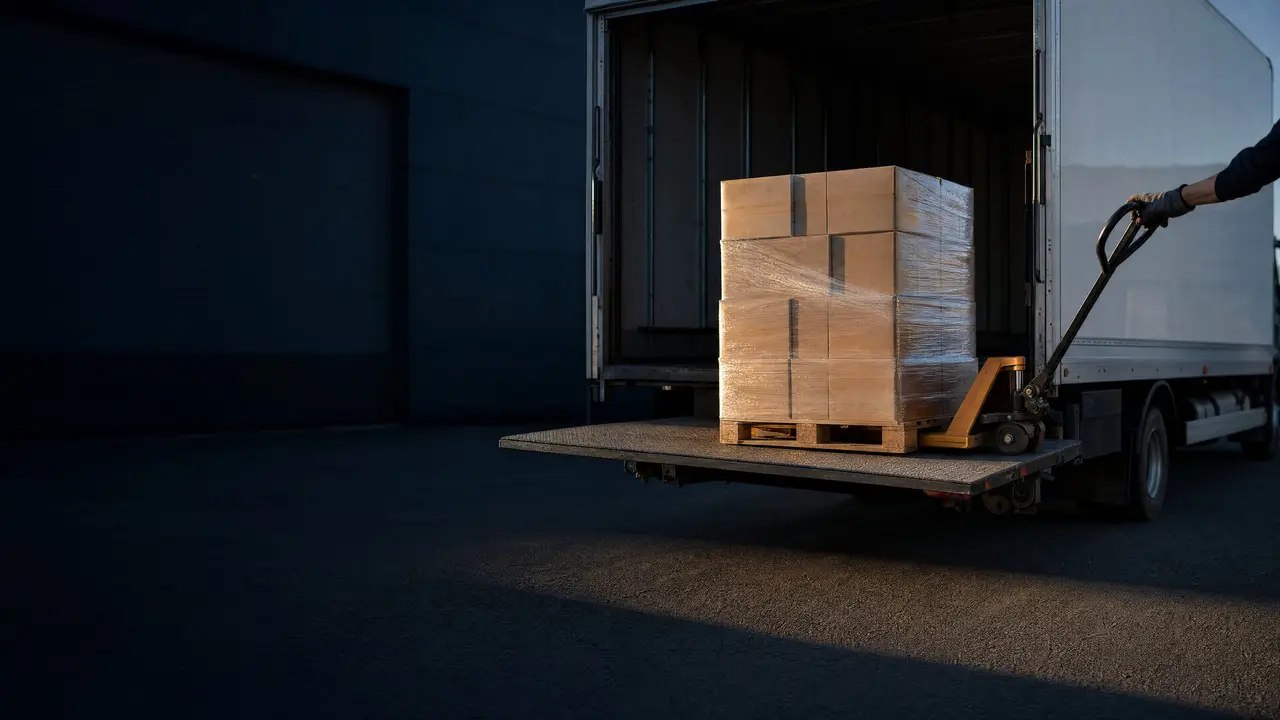
Same-day pallet delivery and pallet transport around Los Angeles
Pallet shipping inside Southern California is simplest with one truck that goes straight from pickup to delivery. Alvy Logistics handles local pallet transport itself, as the motor carrier, with drivers running 20 to 26 ft box trucks across Los Angeles County, Orange County and the Inland Empire. No terminal sits in the middle, so local pallet runs often go the same day when the pallet is ready in the morning.
Booked this way, the box truck works as a pallet courier. One driver picks up, drives straight to the delivery address and unloads, with no cross-dock or transfer on the way, which is what makes same-day pallet delivery possible when the pallet is booked during business hours.
The price follows the truck and the miles rather than the pallet count: from $200 for the first 20 miles, then mileage set on your quote, whether the truck carries one pallet or ten. Heavy loads and other extras are added only when the job needs them. Box truck delivery covers truck sizes and how many pallets fit.
How much does it cost to ship a pallet?
Inside Southern California, one pallet or several on a box truck starts at $200, and that base covers the first 20 miles. After the first 20 miles, mileage can start as low as $1.20 a mile, depending on the vehicle and the route, and it is set on your written quote. Here is how that works for one pallet under 1,000 lbs on a few common runs. Distances are approximate driving miles; your quote uses the actual route.
| Route | About | Dock to dock, before extras |
|---|---|---|
| City of Industry to Pomona | 16 miles | From $200, with the whole run inside the base |
| Burbank to Santa Monica | 24 miles | From $200 for the first 20 miles, plus mileage for the last 4 |
| Valencia to downtown Los Angeles | 40 miles | From $200 for the first 20 miles, plus mileage for the other 20 |
| Downtown Los Angeles to Irvine | 40 miles | From $200 for the first 20 miles, plus mileage for the other 20 |
Each line covers the truck and the miles only. A liftgate or pallet jack, a pallet over 1,000 lbs or an extra delivery stop is added only when the job needs it and listed on your written quote. The freight shipping costs guide has the wider picture.
Shipping pallet freight out of Southern California
Pallets headed for Fresno, the Bay Area, Reno or Salt Lake City usually travel LTL, sharing a trailer with other freight. Those shipments are arranged through Accurate Freight Systems LLC, the licensed property broker in our group (MC-572734), which books an authorized LTL carrier to haul them. Because an LTL rate depends on lane, weight and freight class, each pallet is quoted on its own. LTL shipping explains how those rates and accessorials are built.
For every freight option from one place, start at freight shipping from Los Angeles.
How do you ship a pallet?
A well-built pallet arrives intact and keeps the class you were quoted. The steps are the same for a run across town or a lane to another state:
- Use a sound pallet. A standard 48 by 40 inch pallet with no cracked or missing boards.
- Stack heavy at the bottom, flat on top. Cartons in tight columns, the heaviest first, with nothing hanging over the edges. Overhang gets crushed, and it adds to the measured size.
- Wrap it to the pallet. Stretch wrap that ties the load to the pallet itself, several turns at the base, plus straps or corner boards on heavy or tall loads.
- Label two sides. Shipper, consignee, piece count and any reference number, with old labels taken off.
- Measure and weigh. Length, width and height at the widest points, and the total weight, pallet included in both.
- Check both ends. No dock or forklift at pickup or delivery means a liftgate, and often a pallet jack to roll the pallet clear.
- Match the paperwork. The bill of lading should describe what is really on the pallet; on LTL, the carrier checks.
How big is a shipping pallet?
The standard US pallet is 48 by 40 inches and about 5 to 6.5 inches tall on its own, depending on how it is built. Other common sizes, such as 42 by 42 or 48 by 48 inches, ship fine but should be listed on the quote, because they change how a truck is loaded.
Height has no single rule. Each LTL carrier sets its own maximum, so give the real built height when you ask for a quote, and mark a pallet that cannot take weight on top as do not stack. Height also feeds the class: a tall, light pallet has more cubic feet per pound, which pushes it into a higher class. The freight class guide has the density chart. On a local box truck run, the limit is the box itself and a load that stays stable.
Liftgate, pallet jack and no-dock addresses
Many pallet deliveries in Los Angeles end at a shop front, a studio, an office or a small unit with no loading dock. A liftgate lowers the pallet from the truck bed to the ground and a pallet jack rolls it to the door. If the pallet has to be broken down and carried inside by hand, a second person can come on the run. Each is added only when the job needs it and listed on your quote, so say at quote time what is at each end.
What to send for a pallet quote
Addresses at both ends, how many pallets, the size and weight of each, what is on them, and whether there is a dock at each end. Add any delivery window, and say whether the pallet should stop at the Valencia warehouse first: held freight sits there until you release it, and pallet storage is from $25 per pallet per month. Then ask for a written pallet quote or call (661) 344-8766.