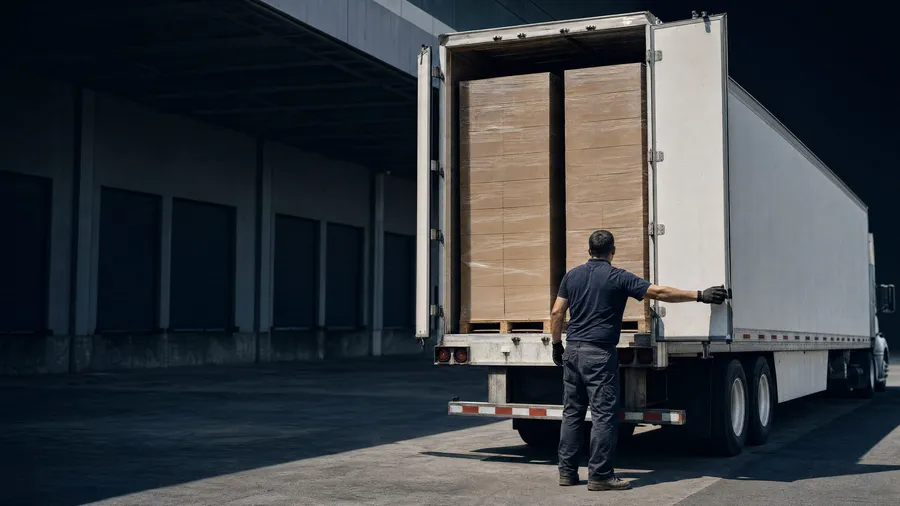

Freight broker vs carrier: what is the difference?
The short answer to freight broker vs carrier: the carrier moves your freight, and the broker arranges for a carrier to move it. Under 49 CFR 371.2, a broker is “a person who, for compensation, arranges, or offers to arrange, the transportation of property by an authorized motor carrier.” The same definition says motor carriers are not brokers when they arrange shipments “which they are authorized to transport and which they have accepted and legally bound themselves to transport.”
In practice:
- A motor carrier holds its own operating authority from FMCSA, puts the freight on a truck it controls and issues the bill of lading. On interstate shipments, 49 U.S.C. 14706 (the Carmack Amendment) makes the carrier liable for the actual loss or injury to the property, subject to any value limit the shipper declared or agreed to in writing.
- A freight broker holds broker authority, accepts your shipment and hires an authorized carrier to haul it. FMCSA describes a property broker as one that “does not assume responsibility for the property and never takes possession of it”. Every broker must keep $75,000 of financial security on file, a BMC-84 bond or BMC-85 trust (49 U.S.C. 13906(b)). The statute makes it available for claims that the broker failed to pay freight charges.
Freight broker vs carrier vs 3PL at a glance
| Motor carrier | Freight broker | Freight forwarder (domestic) | 3PL | |
|---|---|---|---|---|
| FMCSA authority | Motor carrier (MC number) | Broker (MC number) | Freight forwarder (FF number) | None as a 3PL; needs its own authority to haul or arrange interstate trucking |
| Moves the freight itself | Yes | No, unless also registered as a carrier | Only if also registered as a carrier | Depends on its authority |
| Takes possession | Yes | No | Yes | Yes, while goods sit in its warehouse |
| Liable for loss or damage in transit | Yes, on interstate moves, under 49 U.S.C. 14706 | Not as a carrier; the carrier it hires is | Yes, as both receiving and delivering carrier | Set by its contract and its authority |
| Who you contract with | The carrier, on its bill of lading | The broker, which contracts the carrier separately | The forwarder, on its own bill of lading | The 3PL, under a services or warehouse agreement |
What is a freight broker, and why use one?
A freight broker is a licensed intermediary. You give it the load; it finds an authorized carrier and manages the shipment until delivery. Shippers use brokers for lanes their usual carriers do not run, for extra capacity in busy weeks, and for one contact across many carriers.
Two rules protect you. A broker must operate and advertise only in the name its registration is issued in, and it may not present itself as a carrier: “Any advertising shall show the broker status of the operation” (49 CFR 371.7). If a company sells you trucking but SAFER shows it as a broker, it is arranging your freight, not hauling it. Ask which carrier will, and read the broker agreement.
Freight broker vs freight forwarder
“Freight forwarder” means two different things. Under 49 U.S.C. 13102(8), a domestic freight forwarder assembles and consolidates shipments, “assumes responsibility for the transportation from the place of receipt to the place of destination,” and uses carriers for the transportation. Section 14706 makes it liable as both receiving and delivering carrier, unlike a broker.
Many people searching freight broker vs freight forwarder mean an international forwarder that books ocean or air freight and handles export paperwork. Ocean freight forwarders are licensed by the Federal Maritime Commission, not FMCSA. On SAFER, neither company in our group shows freight forwarder authority.
Freight broker vs 3PL: is a 3PL a broker?
A 3PL (third-party logistics provider) runs part of your supply chain for you: receiving, storage, pick and pack, kitting and the shipping around it. “3PL” is not an FMCSA authority type. FMCSA issues motor carrier, broker and freight forwarder authority, so a 3PL’s freight work runs under one of those. Some 3PLs hold broker authority, some hold carrier authority, some hold both. When people say “3PL brokerage,” they usually mean a 3PL’s freight desk working under broker authority.
For any 3PL vs freight broker decision, ask two questions: whose name goes on the bill of lading, and what does SAFER show for that name?
Asset-based vs non-asset: does a carrier need to own trucks?
Asset-based means the company runs its own tractors and trailers. Non-asset covers two different businesses: brokers, which never haul, and carriers that haul with owner-operators or contractor drivers who bring their own vehicles. The second kind is still the carrier on your shipment. What makes a company the carrier is its authority and its acceptance of legal responsibility for the load (the 371.2 test above), not who holds the vehicle title.
Our own carrier is a non-asset example. ALVY BROS DELIVERS INC holds the carrier authority, and its vetted independent-contractor drivers supply the cars, cargo vans and 20 to 26 ft box trucks.
Courier vs carrier: what is the difference?
“Carrier” is a legal role and “courier” is a type of service. Federal law defines a motor carrier as “a person providing motor vehicle transportation for compensation” (49 U.S.C. 13102(14)), so a courier delivering for pay is a carrier in that sense. In business delivery, “courier” usually means small, time-sensitive loads carried by one driver from pickup to delivery, with no sorting hub in between. On our rate card, a same-day courier run by car starts at $45, and that base covers 20 miles.
How our group is set up: a worked example
| Role | Company | FMCSA record (SAFER, data as of 10/02/2026) | What it does for you |
|---|---|---|---|
| Carrier | ALVY BROS DELIVERS INC, trading as Alvy Logistics | USDOT 3443448, MC-1341979, authorized for Motor Carrier of Property (Except Household Goods) | Courier runs and local and regional freight, hauled by its contractor drivers |
| Broker | Accurate Freight Systems LLC | USDOT 2237130, MC-572734, authorized for Broker of Property (Except Household Goods) | Arranges LTL and truckload lanes beyond our own routes with other authorized carriers |
| 3PL | The Valencia warehouse | No FMCSA authority needed for storage | 58,000 sq ft, ambient and dry: storage, pick and pack, kitting, returns, cross-docking |
A local pallet run or a box truck load is hauled by ALVY BROS DELIVERS INC as the carrier. A truckload to Phoenix moves under freight brokerage through Accurate Freight Systems LLC, the licensed property broker in our group, which books an authorized carrier for it. Freight that needs to stop first goes into the warehouse, which is the 3PL side. Before you book, ask which of the two companies is responsible for each leg.
How to check any company on FMCSA SAFER
- Open the FMCSA SAFER Company Snapshot and search by USDOT number, MC number or company name.
- Read Entity Type: CARRIER, BROKER or both.
- Check that USDOT Status is ACTIVE and that Operating Authority Status says “AUTHORIZED FOR” the role you are hiring them for. “NOT AUTHORIZED” means no active interstate authority of that kind.
- Note the docket under MC/MX/FF Number(s), and match the legal name to the name on your quote and contract.
- Use the Licensing and Insurance link on the snapshot to see the filings on record, including a broker’s financial security.
Try it with our two numbers: USDOT 3443448 and USDOT 2237130. Accurate Freight Systems LLC has the federally required $75,000 broker security on file.
Which one should you hire?
- A carrier for freight it runs itself: local and regional pallets, box truck loads, courier work. Fewer hand-offs, one company responsible.
- A broker for lanes outside a carrier’s area or many lanes at once, licensed in its own name.
- A 3PL when the freight is one part of storage and fulfillment, after checking which authority its freight desk uses.
For long-haul freight, the LTL shipping page and the LTL vs FTL guide explain the options. To find out which of our companies would handle your load, request a written quote.