What is freight class?
Freight class is the rating an LTL carrier uses to price your shipment. The rating is set in the National Motor Freight Classification (NMFC), which the National Motor Freight Traffic Association (NMFTA) maintains. NMFTA explains that each commodity is assigned one of 18 classes, from 50 to 500, using four transportation characteristics:
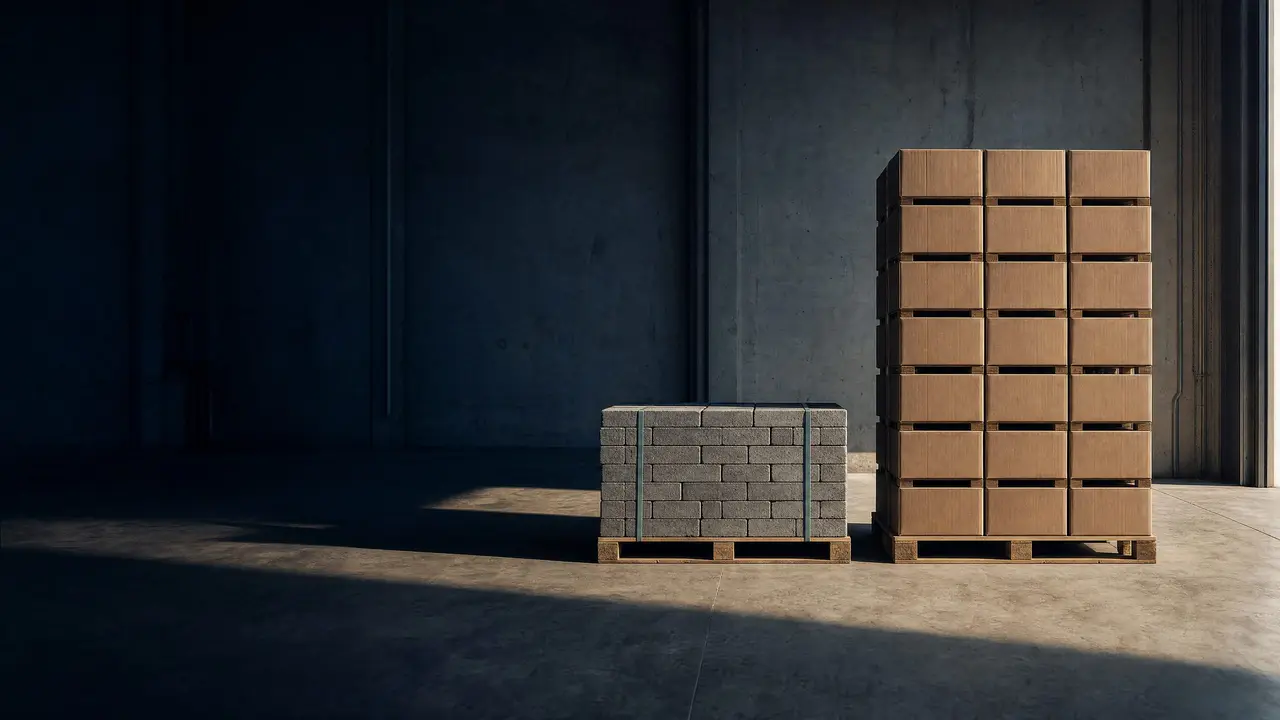
- Density: “How heavy the freight is relative to the space it takes up.”
- Handling: “How easy it is to move across a dock and into or out of a trailer.”
- Stowability: “How effectively it can be stowed in a trailer for transport.”
- Liability: “How likely the freight is to cause damage or be damaged.”
NMFTA sums it up: the denser and easier to move, the lower the class and the lower the cost. Class matters most for LTL. Truckload is usually priced for the whole trailer, as the LTL vs FTL guide explains.
Freight class chart (NMFC 13-step density scale)
This is the standard density scale NMFTA published for the 2025 NMFC changes. Density is in pounds per cubic foot (pcf).
| Sub | Density (lbs per cubic foot) | Freight class |
|---|---|---|
| 1 | Less than 1 | 400 |
| 2 | 1 but less than 2 | 300 |
| 3 | 2 but less than 4 | 250 |
| 4 | 4 but less than 6 | 175 |
| 5 | 6 but less than 8 | 125 |
| 6 | 8 but less than 10 | 100 |
| 7 | 10 but less than 12 | 92.5 |
| 8 | 12 but less than 15 | 85 |
| 9 | 15 but less than 22.5 | 70 |
| 10 | 22.5 but less than 30 | 65 |
| 11 | 30 but less than 35 | 60 |
| 12 | 35 but less than 50 | 55 |
| 13 | 50 or greater | 50 |
Source: NMFTA, “Decoding Density” (June 2025) and NMFTA’s 2025 NMFC changes FAQ.
The chart applies to NMFC items that reference the standard density scale. Items with known handling, stowability or liability concerns keep their own classes or their own density breaks. Of the 18 classes, the other five (77.5, 110, 150, 200 and 500) are not on this scale and come only from item-specific classes or density breaks.
What changed in the 2025 NMFC update?
NMFC Docket 2025-1 went into effect on July 19, 2025, in what NMFTA called one of the most significant updates in the NMFC’s history. Three changes matter to shippers:
- Density first. Many items that used to carry a fixed class by commodity are now classed by the density of the shipment as tendered.
- A longer scale. The standard density scale grew from 11 steps to 13. Step 11 now covers 30 to just under 35 pcf at class 60, and two new steps put 35 to just under 50 pcf at class 55 and 50 pcf or more at class 50.
- Fewer items. Item descriptions with no known handling, stowability or liability concerns were canceled and folded into density-based items under their generic headings.
NMFTA has kept canceling and consolidating items in later dockets, so look up the current item for your product rather than relying on an old bill of lading. The practical effect: the same product can now rate differently depending on how it is packed.
How do you calculate freight density?
NMFTA’s method is to multiply “the greatest straight-line dimensions of length, width, and height (depth) in inches, including all projections, if any, as tendered to the carrier for shipment,” then divide by 1,728 cubic inches, which is one cubic foot. Density is the weight of the handling unit as tendered divided by those cubic feet.
- Measure the handling unit at its longest points, in inches, with the pallet and any overhang included.
- Multiply length x width x height and divide by 1,728 to get cubic feet.
- Divide the total weight, pallet included, by the cubic feet. That is your freight density in pcf.
- Find that density on the chart above.
For a shipment of several pallets, the NMFC rule NMFTA quotes in its FAQ (Item 110, Sec. 8(d)) is that density is calculated on each handling unit, unless the shipping papers show only a total weight, in which case the total weight and total cube may be used.
Freight class calculator: worked examples
Each example is a standard 48 x 40 in pallet. That footprint is 13.33 square feet, so every foot of height adds 13.33 cubic feet.
| Pallet (L x W x H) | Weight | Cubic feet | Density | Class |
|---|---|---|---|---|
| 48 x 40 x 45 in | 450 lbs | 50.0 | 9.0 pcf | 100 |
| 48 x 40 x 50 in | 700 lbs | 55.6 | 12.6 pcf | 85 |
| 48 x 40 x 72 in | 300 lbs | 80.0 | 3.75 pcf | 250 |
| 48 x 40 x 36 in | 1,500 lbs | 40.0 | 37.5 pcf | 55 |
The first row is NMFTA’s own example: 48 x 40 x 45 in is 86,400 cubic inches, divided by 1,728 is 50 cubic feet, and 450 lbs divided by 50 is 9.00 pcf. These classes apply only if your item uses the standard density scale.
How do you determine freight class for your product?
- Find the NMFC item that describes your product. NMFTA’s own ClassIT+ tool finds item numbers and calculates density, and your carrier or supplier may already know the item number.
- Read the item. If it references the 13-step density scale, calculate density and use the chart.
- If it does not, use the class or density breaks the item itself assigns.
- Put the NMFC item number and class on the bill of lading, with accurate dimensions and weight for each handling unit.
What happens if the freight class is wrong?
LTL carriers check what they haul. If the dimensions, weight or item on your bill of lading do not match the freight, the carrier can reclassify the shipment and bill it at the corrected class. NMFTA’s advice is that shippers who capture accurate handling unit dimensions and weight reduce classification changes. Measure in inches, weigh on an accurate scale, and record each pallet separately.
How can you lower your freight class?
- Build square, tight pallets. Overhang and loose cartons count, because the measurement includes all projections.
- Cut empty height. The same weight on a shorter pallet is denser, which can move it down a class.
- Use the right pallet. An oversized pallet adds cube without adding product.
- Check the item, not habit. A class that was right before July 2025 may not be right now.
Freight class and your shipping quote
Freight class is one input to an LTL rate, along with weight, lane and accessorials. The freight shipping costs guide covers the rest. For how we handle LTL shipping and single pallet shipping, see those pages, or request a quote with the dimensions and weight of each pallet.